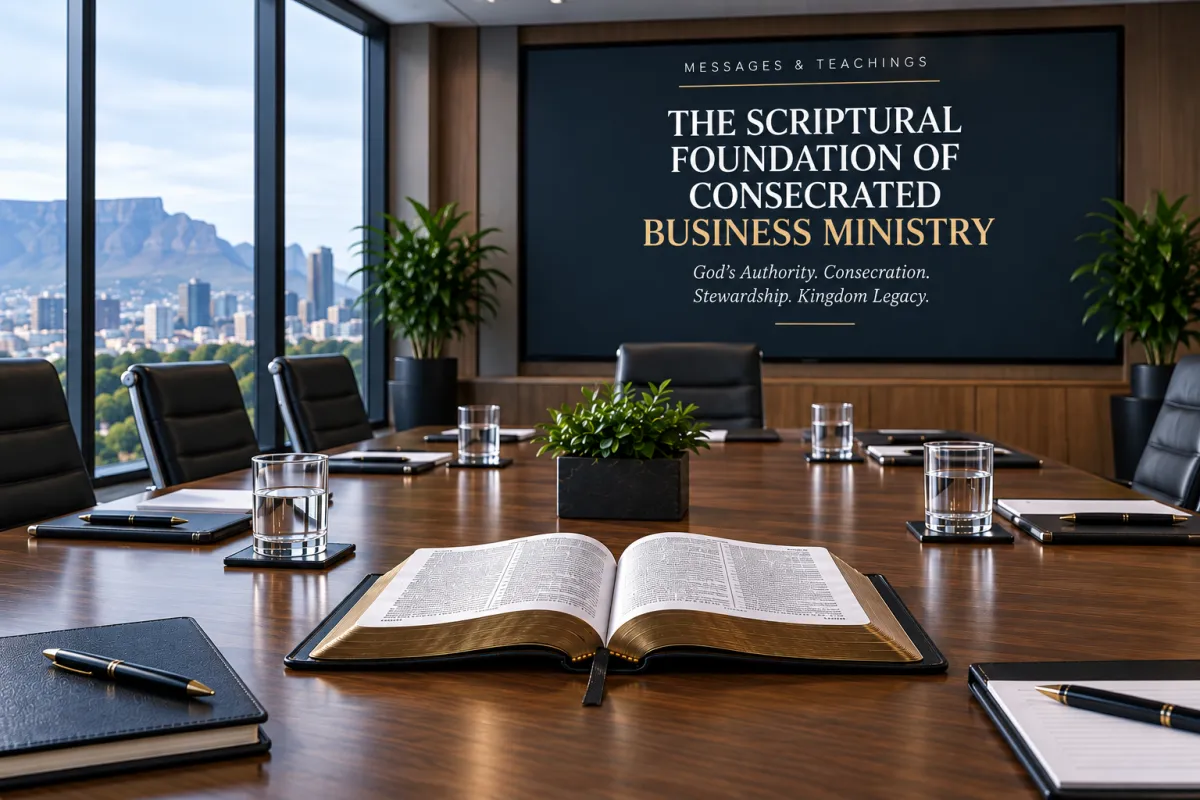
THE SCRIPTURAL FOUNDATION OF CONSECRATED BUSINESS MINISTRY
Understanding God's Authority, the Sacredness of Work, and the Biblical Mandate for Marketplace Stewardship
Introduction: Why Scripture Must Be Our Foundation
Consecrated Business Ministry (CBM) is founded upon the conviction that business, work, leadership and economic activity are not separate from the life of faith. They are among the areas of human responsibility that must be brought under the Lordship of Jesus Christ.
We do not believe that business becomes sacred merely because its owner is a Christian, because prayers are offered over its operations, or because Scripture is displayed in the workplace. A business becomes an expression of consecrated stewardship when its owner consciously submits its purpose, decisions, practices, relationships and resources to God's authority.
This conviction requires a biblical foundation. Without Scripture, consecration can become a personal preference, prayer can become a ritual for obtaining favourable outcomes, and business ministry can gradually become another form of motivational or entrepreneurial support.
The Word of God provides the authority by which we understand our assignment, examine our conduct, form our convictions and discern how we ought to build.
The purpose of this teaching is therefore to establish the biblical principles that govern Consecrated Business Ministry and explain why we approach business owners, their work and their families through prayer, formation, stewardship and discipleship.
1. God Is the Owner; We Are Stewards
Psalm 24:1; Deuteronomy 8:18; 1 Corinthians 4:2
The first principle of consecrated business is that ownership begins with God.
Psalm 24:1 declares that the earth and its fullness belong to the Lord. This establishes a fundamental distinction between divine ownership and human stewardship.
A person may legally register a company, acquire property, develop intellectual property, employ workers and build a profitable enterprise. These are legitimate forms of earthly ownership. Yet, from a biblical perspective, the person remains accountable to God for how those resources are acquired, managed and used.
Deuteronomy 8:18 reminds God's people to remember Him as the source of their ability to produce wealth. This instruction guards against the belief that achievement gives human beings independence from God.
Consecrated Business Ministry therefore teaches that business success must not become a reason to forget the One who has entrusted us with the ability, opportunity and responsibility to build.
Stewardship asks questions that ownership alone may never ask.
What is God's purpose for the resources entrusted to me? How should I treat the people who contribute to this work? What must govern my decisions when profit and integrity appear to compete? What responsibilities accompany the opportunities I have received?
The biblical requirement for a steward is faithfulness.
This means that profitability, growth and public recognition cannot be the only measures by which a consecrated business is examined.
Our foundational conviction: God is Boss.
This is not merely a ministry slogan. It is a declaration that God's authority must govern the person, the assignment and the manner in which the assignment is carried out.
2. Work Was Established Before the Fall
Genesis 1:26–28; Genesis 2:15
Work is not presented in Scripture as a punishment that began after humanity sinned.
Before the fall, God placed humanity within creation and entrusted human beings with responsibility.
Genesis 1:26–28 describes humanity's calling to exercise dominion, be fruitful and multiply. Genesis 2:15 records that God placed Adam in the garden to work it and take care of it.
These passages establish that productive responsibility, cultivation and care formed part of humanity's original assignment.
The fall introduced frustration, hardship and disorder into human labour, as described in Genesis 3:17–19. It did not create the original purpose of work.
This distinction matters to Consecrated Business Ministry.
We do not approach business merely as a means of escaping poverty, accumulating wealth or achieving personal independence. We recognise work as an arena in which human beings exercise responsibility before God.
Business can provide opportunities to cultivate resources, solve problems, create employment, develop people, serve communities and contribute to the wellbeing of others.
However, the biblical command to exercise dominion does not authorise exploitation, oppression or irresponsible control.
The responsibility to cultivate must remain joined to the responsibility to care.
A consecrated business owner must therefore ask not only what the enterprise can produce, but also what the enterprise is becoming under their leadership.
3. Consecration Begins with the Person
Romans 12:1–2; 2 Timothy 2:20–21
Consecration means being set apart for God and His purposes.
Romans 12:1–2 calls believers to offer themselves to God and undergo transformation through the renewing of their minds.
The passage establishes an important order: the person is presented to God before the work of that person is examined.
A business cannot be separated from the character, convictions and decisions of those who lead it.
The founder may establish policies, financial systems and operational procedures, but the direction of the enterprise will also be influenced by what the founder believes, desires, fears, tolerates and values.
Consecrated Business Ministry therefore begins with the business owner.
We invite the person to examine their relationship with God, their understanding of stewardship, their habits, their leadership and the areas of life that may not yet have been consciously submitted to Christ.
This is not an invitation to abandon professional knowledge or practical business responsibility. It is an invitation to bring those responsibilities under renewed thinking and biblical conviction.
A consecrated founder remains responsible for learning, planning, developing systems, seeking qualified advice and making informed decisions.
Prayer does not replace responsibility.
Consecration changes the authority under which responsibility is exercised.
The business owner is not merely being equipped to build a better enterprise. The person is being formed to become a faithful steward of what God has entrusted to their hands.
4. Business as an Altar of Surrender and Obedience
Genesis 12:7–8; Romans 12:1; Colossians 3:17
Throughout Scripture, altars are associated with worship, remembrance, sacrifice, covenant and encounters with God.
In the New Testament, Romans 12:1 presents the believer's life as a living sacrifice offered to God.
Consecrated Business Ministry uses the language of the altar to express the continuing surrender of the person and their work to God's authority.
We do not teach that a business is a literal sacrificial altar, nor that Christian business owners must establish physical altars to secure divine favour.
Rather, the altar expresses a spiritual posture of worship, submission, examination and obedience.
When a founder brings the business before God, the invitation extends beyond asking Him to increase sales, provide contracts or remove obstacles.
The founder also asks God to examine motives, expose dishonesty, correct harmful practices, restore neglected responsibilities and establish righteous conduct.
The altar is therefore not simply where business requests are presented.
It is where the business owner returns to the authority of God.
This understanding shapes the ministry's invitation:
Come to the altar.
Bring the work.
Receive what is needed.
Return to the marketplace prepared to steward faithfully what God has entrusted to you.
The purpose is not to create dependence upon a ministry, its leaders or its gatherings. It is to strengthen the believer's continuing relationship with God and capacity for faithful stewardship.
5. The Priesthood of Believers and Marketplace Responsibility
1 Peter 2:5, 9; Hebrews 4:14–16; Colossians 3:23–24
The New Testament describes believers as a holy priesthood and a royal priesthood.
Through Jesus Christ, believers have access to God and are called to offer spiritual sacrifices acceptable to Him.
This priesthood is not confined to church gatherings.
The Christian business owner remains a believer when negotiating contracts, managing employees, reviewing financial statements, resolving disputes or making strategic decisions.
The marketplace does not suspend the believer's responsibility to live before God.
Consecrated Business Ministry therefore encourages business owners to develop a life of prayer, Scripture, worship and obedience that accompanies them into their daily work.
The ministry does not replace Christ's priesthood or assume exclusive spiritual authority over another person's business.
Jesus Christ remains our great High Priest.
Our responsibility is to teach, encourage, pray, disciple and equip believers to approach God confidently and live faithfully before Him.
Colossians 3:23–24 calls believers to work wholeheartedly as serving the Lord.
This gives everyday responsibilities spiritual significance without removing the need for professional competence and accountability.
A business owner who prays must still honour agreements.
A leader who worships must still treat employees justly.
A founder who speaks about divine provision must still manage resources responsibly.
Marketplace priesthood is expressed through a life of worship and obedience, not through religious language alone.
6. Justice, Integrity and the Treatment of People
Proverbs 11:1; Micah 6:8; James 5:4; Matthew 7:12
Biblical stewardship cannot be separated from justice.
Proverbs 11:1 condemns dishonest measures, while James 5:4 warns against withholding wages from workers.
These passages demonstrate that God is concerned not only with what people believe, but also with how they conduct economic relationships.
A business may display Christian language while practising dishonesty, exploitation or unfair treatment.
Such conduct contradicts the biblical principles the business claims to uphold.
Consecrated Business Ministry therefore recognises integrity as an essential expression of consecration.
This includes truthful communication, fair treatment, responsible financial management, respect for agreements, lawful conduct and appropriate accountability.
It also includes recognising the dignity of customers, employees, suppliers, partners and communities.
The business owner must not use spiritual authority to silence legitimate questions, excuse misconduct or pressure others into decisions.
Prayer must never become a substitute for justice.
A business brought under God's authority must remain open to correction wherever its conduct contradicts His Word.
7. Formation, Discipleship and Maturity
Matthew 28:18–20; Ephesians 4:11–16; Hebrews 5:14
Consecrated Business Ministry understands discipleship as an ongoing process of learning to live under the Lordship of Jesus Christ.
Matthew 28:18–20 commissions the making of disciples and the teaching of obedience to Christ's commands.
This calling is not limited to teaching believers how to participate in church activities. It concerns the formation of people whose lives increasingly reflect the teachings of Christ.
For business owners, discipleship must reach the areas in which they exercise responsibility.
These include leadership, financial stewardship, decision-making, relationships, work habits, conflict resolution, family responsibilities and the use of influence.
Formation is therefore more than receiving information.
It involves learning, examination, practice, correction and growth.
Consecrated Business Ministry does not assume that every business owner requires the same form or duration of support.
Some may need a foundational teaching.
Others may need prayer during a difficult season, practical guidance, structured discipleship or referral to an appropriately qualified professional.
The aim is not to keep every person permanently within a programme.
The aim is to serve according to the need, encourage maturity and strengthen the person's capacity to continue faithfully.
We measure the purpose of our service by the formation and faithful stewardship of people, not by how long they remain dependent upon us.
8. The Family, Generational Stewardship and Kingdom Legacy
Deuteronomy 6:6–9; Psalm 78:4–7; Proverbs 13:22; 2 Timothy 1:5
Scripture repeatedly presents faith as something that must be taught, remembered and transmitted across generations.
Deuteronomy 6 calls God's people to teach His commands diligently within the ordinary rhythms of family life.
Psalm 78 emphasises the responsibility to tell coming generations about the works of God so that they may place their hope in Him.
This provides a foundation for understanding legacy beyond the transfer of material possessions.
A business may create resources that support a family across generations. Yet material inheritance alone does not guarantee wisdom, righteousness or faithful stewardship.
Consecrated Business Ministry therefore recognises the importance of preparing both the founder and those who may follow.
This preparation includes teaching biblical convictions, developing responsible stewardship, cultivating character and establishing appropriate governance and succession arrangements.
A founder may pass on a business without passing on the wisdom required to steward it.
Equally, a person may leave a legacy of faith, integrity and service even where no business or substantial material inheritance remains.
Our concern is therefore broader than business succession.
We desire that the knowledge of God, the practice of faithful stewardship and the testimony of His work may continue beyond one individual and one generation.
The greatest inheritance is not merely what a founder leaves behind, but the knowledge of God and the wisdom with which future generations learn to steward what has been entrusted to them.
9. The Marketplace as a Place of Witness and Service
Matthew 5:13–16; Matthew 25:14–30; Ephesians 2:10
Jesus calls His followers to be salt and light.
This calling extends into the ordinary places where believers live and work.
The marketplace provides opportunities for Christian witness through conduct, relationships, service, excellence, generosity and integrity.
A consecrated business does not need to turn every commercial interaction into a religious conversation to demonstrate biblical values.
Its witness should also be visible in the way it fulfils its responsibilities.
The parable of the talents in Matthew 25:14–30 illustrates accountability for what has been entrusted to servants. Although the parable is not a modern business manual, it offers important principles concerning responsibility, faithfulness and accountability.
Consecrated Business Ministry draws from these principles without reducing the Kingdom of God to commercial success.
A profitable enterprise is not automatically evidence of spiritual maturity.
A struggling business is not automatically evidence of divine displeasure.
Faithful stewardship must be examined through a broader biblical understanding of obedience, responsibility, justice, wisdom and perseverance.
Our calling is to equip business owners to serve God faithfully within the circumstances and responsibilities entrusted to them.
10. Christ Must Remain the Centre
Colossians 1:15–20; John 15:4–5; Matthew 6:33
The foundation of Consecrated Business Ministry is not entrepreneurship itself.
It is Jesus Christ.
Colossians 1:15–20 presents Christ's supremacy over creation and His central place in God's redemptive purpose.
John 15:4–5 teaches believers the necessity of abiding in Christ.
Matthew 6:33 calls believers to seek first God's Kingdom and righteousness.
These passages guard the ministry against allowing business growth, organisational expansion, influence or financial provision to become its ultimate purpose.
Business is an assignment.
Christ is Lord.
The ministry exists to help people bring their assignments into alignment with the One they serve.
We do not promise that consecration will eliminate hardship, guarantee profit or produce immediate commercial success.
We teach that faithfulness to God must remain the governing commitment through seasons of growth, difficulty, rebuilding, transition and release.
The business owner must never become so attached to the enterprise that the enterprise replaces God.
Neither should the ministry become so attached to those it serves that it forgets its responsibility to equip and release them.
Our task is to point people continually to Christ.
What These Scriptures Establish for Consecrated Business Ministry
Taken together, these biblical foundations establish the convictions through which CBM understands and carries out its assignment.
God is the ultimate owner of all things, and human beings are accountable for what has been entrusted to them.
Work is part of humanity's created responsibility, while consecration calls the believer to exercise that responsibility under God's authority.
The business owner must be formed alongside the enterprise.
Prayer, worship and Scripture must shape daily conduct rather than remain separate religious activities.
Integrity, justice and love must govern the treatment of people.
Discipleship must encourage maturity rather than permanent dependence.
Families and future generations should receive not only resources, but also wisdom and the knowledge of God.
Above all, Jesus Christ must remain the centre of the person, the work and the ministry.
These convictions form the foundation of our approach to prayer, formation, marketplace intercession, teaching and the practical support of business owners.
A Foundational Question for Every Business Owner
As you consider these Scriptures, reflect upon the following question:
What in my leadership, habits or business needs to come under the Lordship of Jesus Christ?
Do not answer only in terms of what you want God to change around you.
Consider what He may be calling you to surrender, learn, correct, strengthen or steward differently.
The invitation to consecration is not merely an invitation to receive something from God.
It is an invitation to belong wholly to Him and to live responsibly with what He has entrusted to your hands.
Closing Prayer
Heavenly Father,
We acknowledge that the earth and everything in it belong to You.
You are the source of our lives, our abilities, our opportunities and every good thing entrusted to our care.
Teach us to recognise Your authority in the work of our hands.
Renew our minds so that we may no longer separate our faith from our responsibilities.
Examine our motives, correct our ways and establish Your truth within us.
Where we have pursued success without wisdom, teach us.
Where we have exercised authority without love, correct us.
Where we have neglected justice, lead us into repentance and restoration.
Where we have carried our assignments without consciously acknowledging You, draw us back into fellowship and dependence upon Your grace.
Form us into faithful stewards.
Let our businesses serve people with dignity, operate with integrity and contribute meaningfully to the communities in which You have placed us.
Give us wisdom to prepare those who will follow, so that our legacy may extend beyond possessions into faith, character and responsible stewardship.
May Consecrated Business Ministry remain submitted to Jesus Christ in its teaching, leadership, service and decisions.
Keep us faithful to Your Word.
May everything entrusted to our hands continually return to Your authority.
In the name of Jesus Christ, our Lord and great High Priest.
Amen.
GOD IS BOSS.
Consecrated Business Ministry — From the Altar to the Marketplace.